
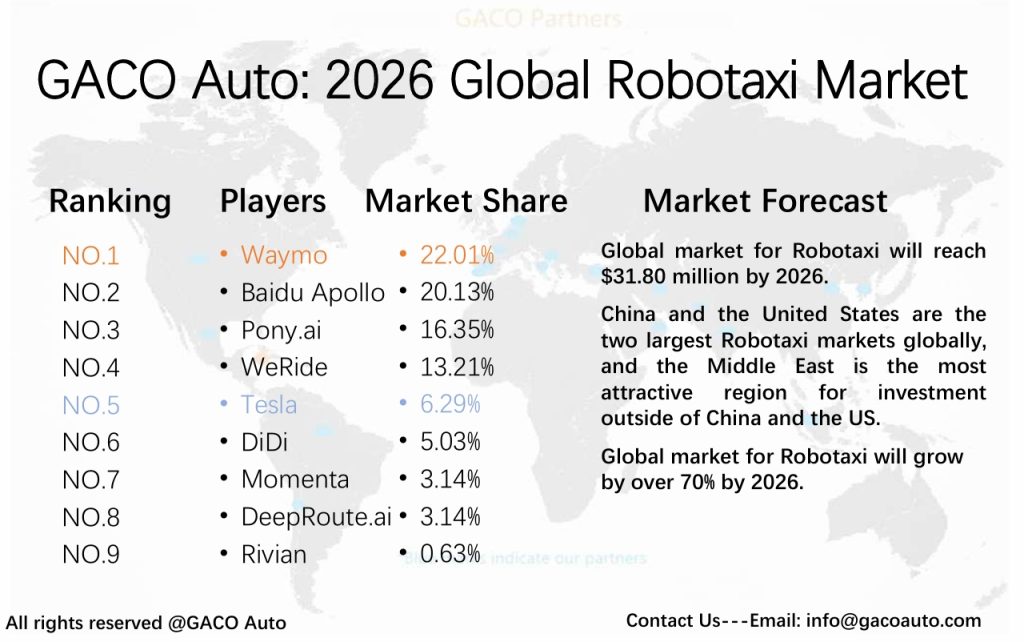
According to the global Robotaxi market report released by GACO Auto, the global Robotaxi market will reach $31.8 million in 2026, with an expected growth rate exceeding 70% in 2026.
Baidu Apollo Go’s global ride-hailing service has accumulated over 20 million rides, making it the first company globally to reach this milestone.
China and the United States are the two largest Robotaxi markets globally, and Chinese companies tend to be more aggressive than their American counterparts in exploring Robotaxi commercialization.
The Middle East is the most attractive region for investment outside of China and the United States. In the third quarter of 2025, Pony.ai’s Robotaxi business in Guangzhou achieved profitability per vehicle; WeRide’s fleet in Abu Dhabi is also close to achieving break-even per vehicle. More Robotaxi companies are expected to achieve profitability per vehicle in 2026.
At the beginning of 2026, the competition in the autonomous driving sector continued to escalate with increased funding and expansion. In February, Waymo announced a massive $16 billion funding round, boosting its post-money valuation to $126 billion. Dragoneer Investment Group, DST Global, and Sequoia Capital led this round of funding, with parent company Alphabet also contributing. Waymo plans to use this funding to aggressively expand into more than 20 cities, including Tokyo and London, in 2026, accelerating its global ride-hailing business expansion.
Looking back, as of the end of 2025, Waymo’s Robotaxi fleet size was only about 2,500 vehicles. However, its paid ride service has grown rapidly, exceeding 1 million rides by the end of 2023, climbing to 5 million rides by the end of 2024, and surpassing 10 million cumulative rides in 2025. Currently, Waymo has deployed autonomous Robotaxi services in four cities in the United States, with plans to add three more cities.

Across the ocean in China, Baidu Apollo Go is leading the way in the autonomous driving field. In the third quarter of 2025, its global ride-hailing service reached 3.1 million rides, a year-on-year increase of 212%. Currently, Baidu Apollo Go handles over 250,000 fully autonomous orders weekly, and its global ride-hailing services have exceeded 20 million trips.
Pony.ai is also making significant progress in the autonomous driving sector. It currently operates over 1,000 Robotaxis globally, with accumulated autonomous driving test mileage exceeding 60 million kilometers, and fully autonomous driving mileage without safety drivers surpassing 15 million kilometers.
Since 2023, Pony.ai’s autonomous vehicle fleet has been conducting regular testing in four major first-tier cities: Beijing, Shanghai, Guangzhou, and Shenzhen. It has also launched shuttle services at important transportation hubs such as Beijing Daxing Airport, Guangzhou Baiyun Airport, Shenzhen Bao’an Airport, and Guangzhou South Railway Station.
With its continuously expanding business footprint, Pony.ai has already mass-produced and deployed 1,000 Robotaxi autonomous vehicles in China; its overseas market presence has also taken root in countries such as South Korea, Singapore, the UAE, Qatar, and Luxembourg.
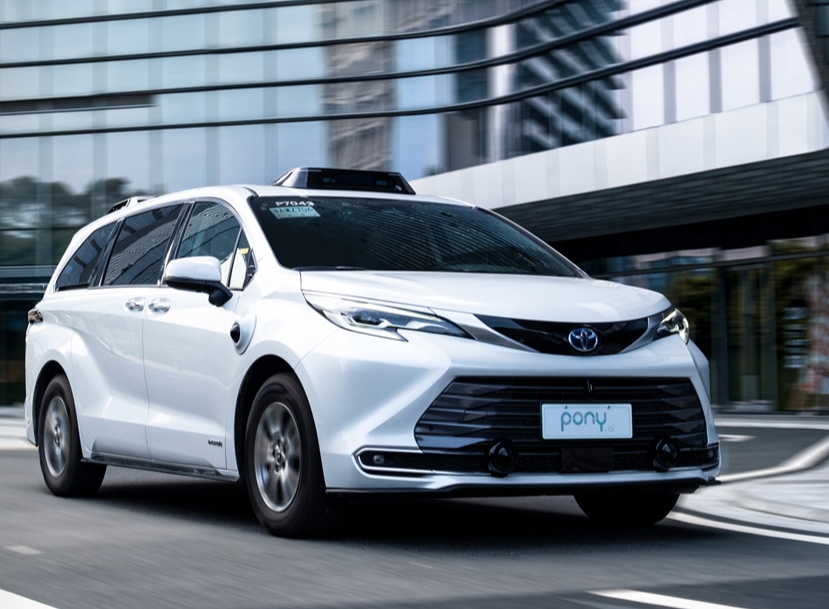
From a financial perspective, in the first half of 2025, Pony.ai’s revenue reached $35.43 million, a year-on-year increase of 43.3%. Robotaxi business revenue reached $3.26 million, a surge of 178.8% year-on-year.
Although net losses increased, the company’s commercialization pace has not slowed down. The third-quarter financial report shows that Pony.ai has achieved profitability per vehicle at the city level, and the target of 1,000 Robotaxis is expected to be achieved ahead of schedule, with the fleet size expanding to 3,000 vehicles in 2026.
As of January 12, 2026, WeRide’s global Robotaxi fleet reached 1,023 vehicles. WeRide Robotaxis are operating in more than 10 core cities worldwide, with commercial operations of fully autonomous Robotaxis in Guangzhou, Beijing, and Abu Dhabi. The Abu Dhabi fleet is expected to achieve break-even soon.
In the future, WeRide will continue to deepen its research and development of autonomous driving technology, striving to achieve the goal of deploying tens of thousands of Robotaxis globally by 2030.
Didi Autonomous Driving recently announced positive news regarding its financing, completing a Series D funding round totaling $300 million, bringing its cumulative publicly disclosed funding to approximately $2 billion. Didi Autonomous Driving stated that the funds will primarily be used to increase investment in AI research and development, promote the implementation of L4 autonomous driving technology, and contribute to the high-quality development of the transportation industry.
Tesla, on the other hand, unveiled a clear expansion roadmap for its Robotaxi service. Currently, its Robotaxi fleet exceeds 500 vehicles, primarily deployed in Austin and the San Francisco Bay Area, with the fleet size expected to double every month. Tesla plans to expand its Robotaxi service to several other US cities, including Dallas, Houston, Phoenix, and Miami, in the first half of 2026.
Meanwhile, Rivian launched its self-developed AI chip, RAP1. This chip will serve as the core of the new generation autonomous driving computing module ACM3, helping the company make significant strides towards L4 autonomous driving technology.
